Home › Forums › Active Melody Guitar Lessons › Tricky Timing Bootcamp?
Tagged: Timing
- This topic has 6 replies, 5 voices, and was last updated 1 year, 9 months ago by
 Gordon M.
-
AuthorPosts
-
-
June 9, 2024 at 9:21 am #371747
Hi,
Timing has always been a weakness for me.
To be clear:
– I can read the music and I fully understand the notation
– I can do the arithmetic and see that the numbers add up
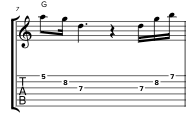
– when 1/8 & 1/16 notes (or triplets or whatever) are “contained” within the space of a quarter note on the beat, I’m fineBut as soon as the timing starts spanning quarter notes/the beat, it breaks me. For example, if a bar starts with an 1/8th, a 1/16 and another 1/8th, the next note (or rest) is part way into beat 2. Throw in a couple of dotted notes and, while I understand it academically, I really have trouble playing it.
As an example, please look at the practice piece with EP374. In many bars, after the first note, subsequent notes are not on the beat.
An example:
Amongst the hundreds of lessons at Active Melody, are there any lessons dedicated to practicing tricky timing?
I’m looking for a Tricky Timing Bootcamp. Is there something out there already?
Thanks,
Gord
-
June 9, 2024 at 11:55 am #371752
Hi Gordon,
I don’t think there is any specific lesson dedicated to timing.
But I’d like to suggest that the tab notation for Brian’s lessons is not meant to be played exactly like written. It’s more of a groove thing than anything else – particularly on very slow rhythms like this one. I suspect that Brian records his lesson in Guitar Pro rather than manually writing them down. I may be wrong, of course.That being said, if you really want to work on rhythmic placement, the only thing I can recommend is the metronome. In the particular case of your example, set the metronome on 16th notes at, say, 40 bpm and then count while you play:
1 2 1 1 2 3 4 5 6 (1 2 3 4) 1 2 3That is the exact decomposition of that bar with 16th notes as unit. One 8th note (2 16th), one 16th note, a dotted quarter note (6 16th), a rest (4 16th) and three 16th notes. Total: 16 16th notes.
Play that several times, until you begin to feel the groove; at that point continue to play without counting; just listen to the clicks of the metronome.
-
June 9, 2024 at 3:19 pm #371756
Back in the days when I was working on timing, I used an incredibly primitive method, but it worked very well for me: For 4 beats per bar, I got a yellow marker pen and marked where within the bar each beat occurred over the troublesome areas. So the yellow marks could be anywhere, like on a quarter note, the first note of a triplet, or even a rest.
Sunjamr Steve
-
June 10, 2024 at 5:24 am #371764
I basically did the same with a downward arrow indicating where each beat fell. I then listened to Brian carefully until I could feel the groove and relate it to my foot tapping up and down. It is really important as the beauty of Brian’s phrasing is in the timing as well as the notes.
John -
June 10, 2024 at 11:49 am #371773
It’s a skill you can exercise, here’s how I learned.
Assign a syllable to each of the 16 16th notes of a measure. A common one is:
1 e & a 2 e & a 3 e & a 4 e & aNext decode the example to figure out where the beats are falling in the grid:
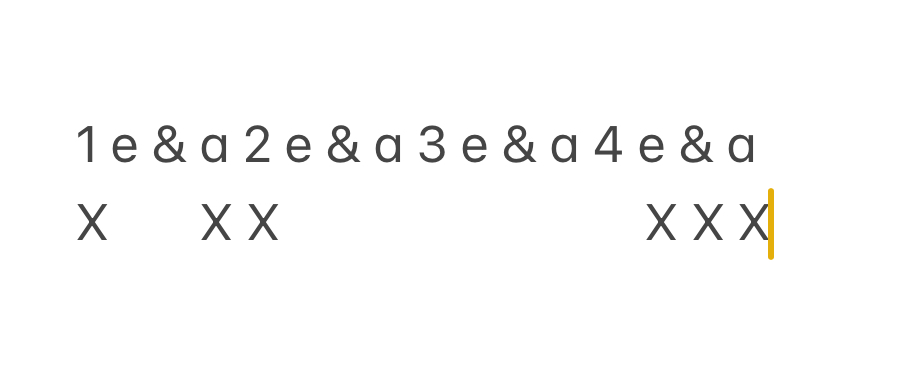
Set a metronome pretty fast, let’s say 160. But that going to be our 16th note, so the actual tempo is 40.
Now- say those syllables while SIMULTANEOUSLY clapping the rhythm you’re trying to learn. Keep at it until you ingrain the new rhythm. Then slowly increase the tempo, eventually going to a regular quarter note pulse on the metronome, until you get to your target tempo.
Bonus exercise- mix up the parts. Clap the subdivision and sing the guitar part, tap your foot for one, do one part in each hand tapping in your lap, etc. the idea is to internalize that beat so there’s a 16th note pulse going in your head as you’re counting new parts.
-
June 10, 2024 at 3:11 pm #371776
Yes, I used that technique also. The beauty of breaking it all down to 1/16 notes is that a lot of funk music is based on 1/16 notes, so you come out of the experience being a better funk player.
Sunjamr Steve
-
-
June 10, 2024 at 4:08 pm #371779
Thanks for the great answers. They help.
Gord.
-
-
AuthorPosts




- You must be logged in to reply to this topic.
