Home › Forums › Members Teaching Members › Playing through changes: a simple trick
- This topic has 2 replies, 3 voices, and was last updated 1 year, 7 months ago by
 John H.
-
AuthorPosts
-
-
September 24, 2024 at 9:01 am #378683
Lots of people struggle with playing smoothly through chord changes. Here is a simple trick that may help.
Whenever there is a chord change, the first note on the change will always be a chord tone (e.g. the root). However, that chord tone will be approached with a note a semitone lower. So the last note right before the change will always be that approach note.
The chord progression in the example below is |C – – – |A – – – |Dm – G – |C – – – |
I used to chord-related pentatonic scales, that is:
– C major pent (C D E G A) over C (C E G),
– A major pent (A B C# E F#) over A (A C# E),
– D minor pent (D F G A C) over Dm (D F A)
– G major pent (G A B D E) over G (G B D).
All those scales are played in 2nd position.Here is the example where I target the roots:
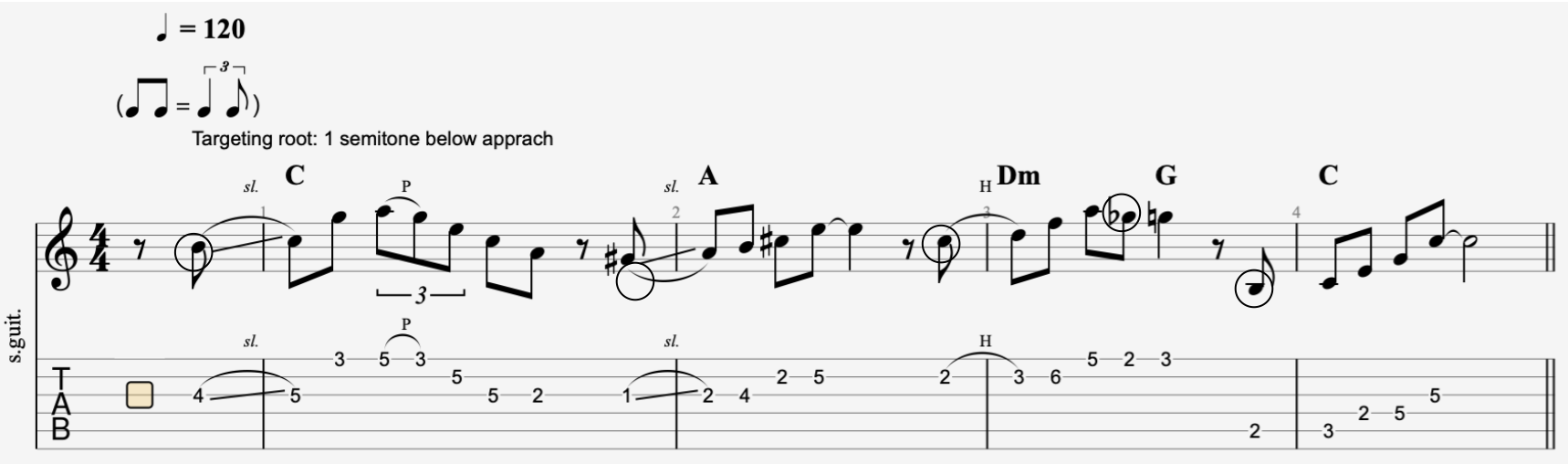
Another possibility is to use enclosures; for example, one tone above the target note and one semitone below it:
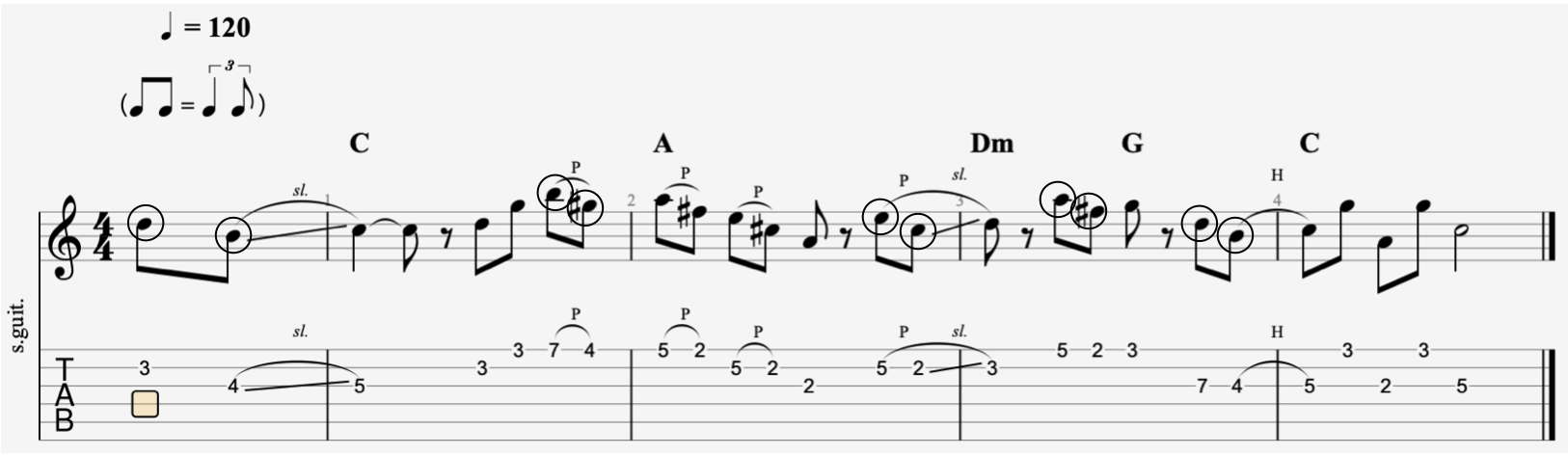
You can of course target other chord tones (the 3rd, the 5th or even the 7th), use other approach notes (e.g. one semitone above), other enclosures, and mix everything as you go!
This not only sounds good, it is also a great exercise in reading the fretboard because you have to spot the target tone in advance!
Have fun! -
September 24, 2024 at 1:12 pm #378698
Hi JM, through Brian’s lessons, lots of practice, and lots of listening to music I’ve begun seeing this. Nice to see it reinforced with your examples. Would love to hear your playing sometime too.
-
September 25, 2024 at 7:05 am #378724
Thank you Jean-Michel. I agree with Michael L. Helpful and interesting reinforcement. Might have to try this myself using Soundslice.
JH
-
-
AuthorPosts



- You must be logged in to reply to this topic.
