Home › Forums › Music Theory › Melodic analysis and improvisation
- This topic has 4 replies, 3 voices, and was last updated 2 years, 1 month ago by
 Jean-Michel G.
-
AuthorPosts
-
-
May 31, 2024 at 5:59 am #371251
Scale degrees and their melodic tendencies
In the major (and minor) keys, some scale degrees are fairly stable and static while others exhibit a more or less strong tendency to move towards other (more stable) notes.Let’s take the major scale: T 2 3 4 5 6 7 T
In the scale, 1 and 3 are the stable degrees, 1 being the most stable: it is the tonic.
The dominant (degree 5) has a very strong tendency to go to the tonic, except when it is part of the I chord.
All the other scale degrees are much more active:
– 4 has a very strong tendency go to 3
– 7 has a very strong tendency to go to 1
– 2 has a tendency to go to 1 (or possibly to 3)
– 6 has a strong tendency to go to 5 (rarely to 7)The same is true for the minor scale, particularly the harmonic minor scale which has a 7 instead of a b7.
The pull on 4 by 3 and on 6 by 5 is so strong that the degrees 4 and 6 are often called tendency tones.
Scale degree 7 is called leading tone. It is arguably the most important tone in tonal music.Melodic cadences
Taking the notes’ stability/instability characteristics into account, we define a number of important melodic movements, called cadences, that are used to conclude melodic phrases. The word “cadence” comes from the latin “cadere” which means “to fall”.– Very conclusive cadences
The melodic movements 2 -> 1 and 7 -> 8 are very conclusive.– Less conclusive cadences
2 -> 3, 4 -> 3 and 5 -> 3 are less conclusive.– Inconclusive cadences
All movements to an active scale degree are inconclusive, in particular 3 -> 2, 6 -> 5 or 8 -> 7. These inconclusive cadences indicate that there is more to come and actually require a complement.Melodic design: reductions
The relative tendency of the various scale degrees to go to neighboring degrees is usually not immediately apparent in the melody of a song, but when we peel away the unessential melodic tones (embellishments) the underlying melodic design becomes much more clear.Let’s look at a very simple example. Below you see a lead sheet (with guitar tab) of the song “Happy Birthday” in the key of G major.
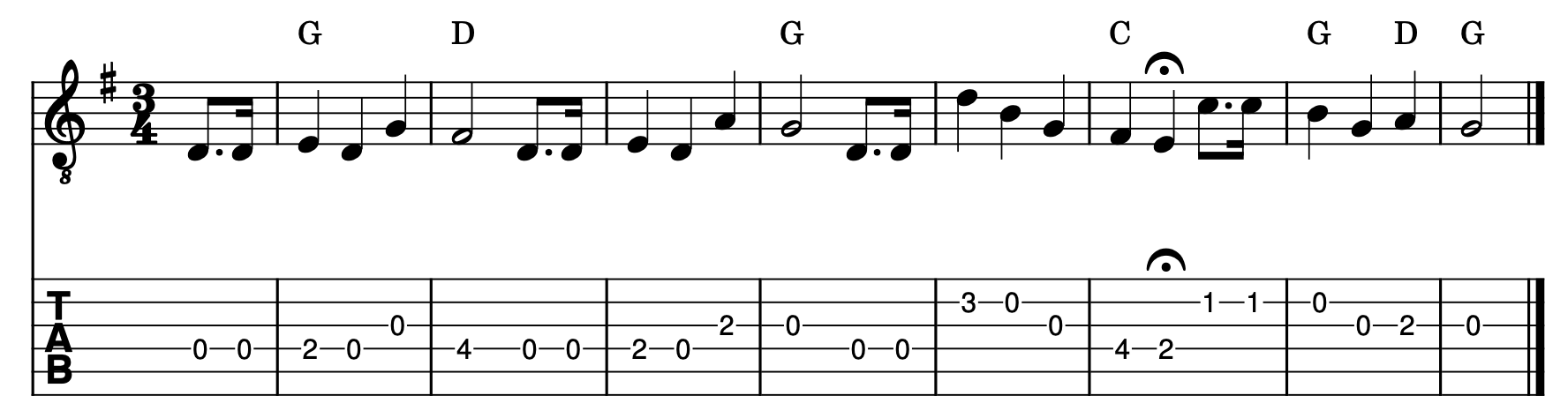
The scale is G = 1, A = 2, B = 3, C = 4, D = 5, E = 6, F# = 7
The very conclusive cadences are A -> G and F# -> G
Less conclusive cadences are A -> B, C -> B and D -> B
Inconclusive cadences include B -> A, E -> D and G -> F#The song is eight bars long (the pickup bar doesn’t count). Let’s try to identify the melodic cadences in this song. This is not so easy on a tab, but easy on a score and even easier if you use your ears!
– We have a 1 -> 7 (G -> F#) inconclusive cadence between bars 1 and 2
– We have a 2 -> 1 (A -> G) conclusive cadence between bars 3 and 4
– We have a 7 -> 6 (F# -> E) inconclusive cadence in bar 6
– We have a final cadence 2 -> 1 (A -> G) between bars 7 and 8
These cadences are phrase markers: each cadence concludes a phrase.In the sheet below, the phrases are indicated by slurs; as you can see, there are four 2-bar phrases. In each phrase we keep the starting note and the phrase cadence; the other notes have their stems removed because they are inessential.
Phrase 1: starts on 5 (D) and ends with 1 -> 7 (call)
Phrase 2: starts on 5 and ends with 2 -> 1 (response)
Phrase 3: starts on 5 and ends with 7 -> 6
Phrase 4: starts on 4 (C) and ends with 2 -> 1
The overall melodic organization of this song is therefore:
– a call 5 -> 7 followed by the response 5 -> 1
– a descending line from 5 -> 6, mostly in 3rds
– a final descending line going stepwise from 4 to 1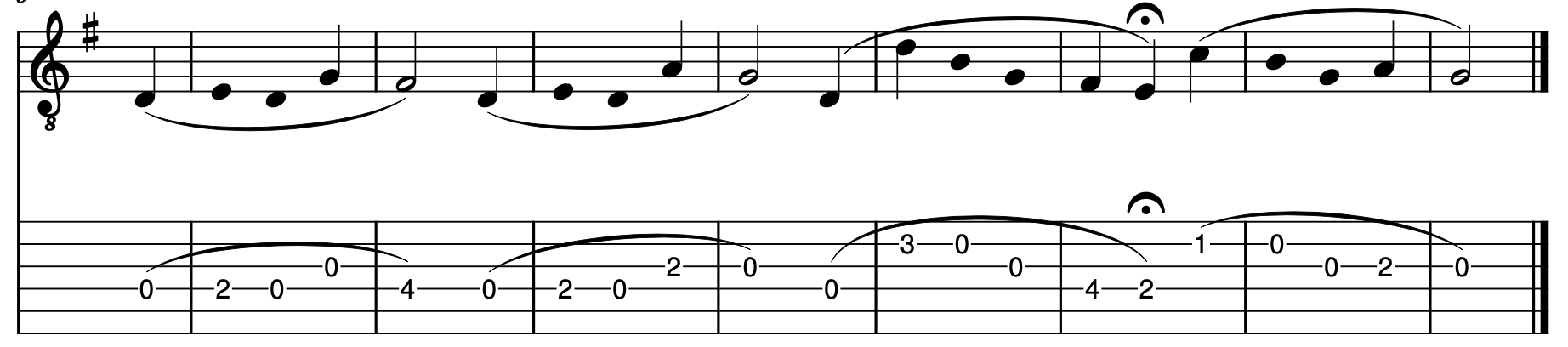
The overall melodic structure of the song is even more apparent in the score below, where all the unessential notes have been hidden. From this broader standpoint, we can see that the song really consists of two parts:
– a stepwise ascent from 7 to 1
– a descent from 5 to 1 (from 5 to 6 and then from 4 to 1)
From this broader perspective, you see that the natural tendencies of the sale degrees tend to be confirmed.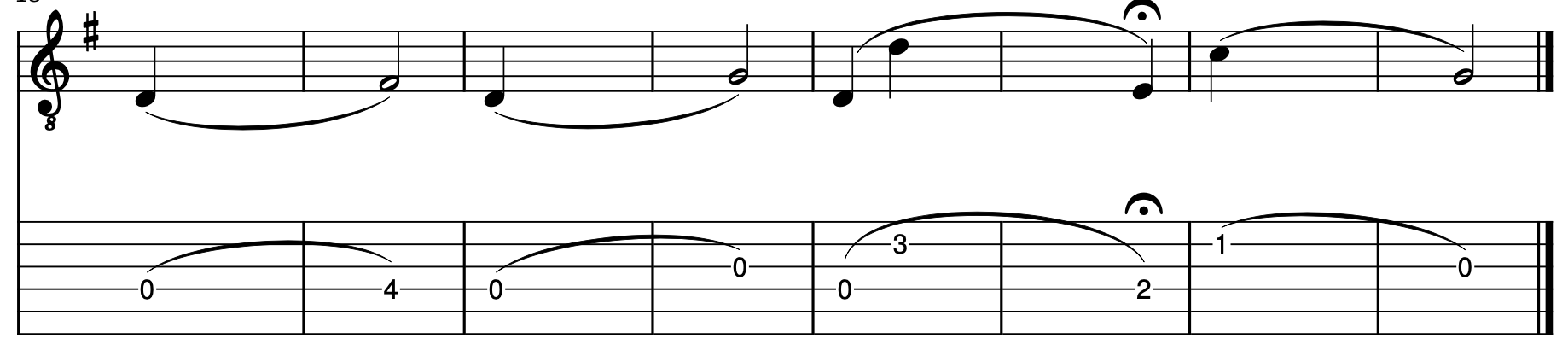
Relevance to improvisation
You may wonder what all this has to do with improvisation?
The point is that the melodic skeleton that we uncovered is what really makes the music move forward, and the cadences in between are important articulations along the way.Improvisation is composition on the fly, and composition is the opposite of what we just did: instead of finding the melodic reduction of a song, we start from that reduction and create an elaboration by adding passing notes, embellishments and what not.
So, playing chord tones (or not) is certainly an important part of an improvisation, but the note choices should also support consistent cadences that structure the musical story.
-
May 31, 2024 at 6:19 am #371256
J-M, given Brian’s lesson on hearing intervals and your analysis of melodic tendencies, do you feel an advanced guitar player needs to be able to identify intervals above and below the tonic of a given key?
John -
May 31, 2024 at 7:49 am #371258
I think that’s a vital skill for an advanced player, yes.
A musician needs to feel at any point in time where s/he is with respect to the current tonal center and where s/he is being attracted to.
-
May 31, 2024 at 4:31 pm #371278
This is fascinating information but I’m now wondering how to make practical use of it when trying to improvise.
Trying to blindly follow these cadences when improvising is going to start sounding very stilted and not really playing what you’re hearing in your head.
Is it better to practice these movements eg 6 -> 5, a bit like scales, to train the ear to hear them, and muscle memory to play them, when we hear that melodic movement coming into our heads when improvising? Or is there another way to practice them that could improve the melodies we come up? ie improve our story telling? -
June 3, 2024 at 1:33 am #371387
Excellent question!
I think the first and most important thing is to start thinking in terms of musical phrases.
This is not easy and requires some thoughtful practice (at least in my case).
Something like this:
Step 1: practice creating isolated phrases (without backing track), evaluate them and try to improve them. Cadences will be naturally present because, as I said, a cadence is a phrase marker.Step 2: try playing groups of phrases that somehow relate to one another; for example, the first phrase ends on an active scale degree while the second one resolves to a stable degree (call and response), like the first two phrases of Happy Birthday.
Step 3: Same as step 3, but with a backing track. This adds a level of complexity because the phrases now also need to blend with the harmony.
Step 4: identify long range targets. For example, the song Happy Birthday reaches a climax point in bar 6 (the E note that is part of a C chord, but is the active degree 6 of the G major scale). If you had to improvise over that song, you might decide to play the note C in that bar instead, and work your way towards that target. In doing so you would respect the melodic logic of the song (C is also a very active scale degree) AND its harmonic structure (C is of course perfectly consonant over a C chord). Setting targets like that avoid the “aimless noodling” syndrome.
Another useful exercise is to start from the actual melody, but change it using melodic devices such as motive transposition, mirroring, rhythmic changes, etc.
-
-
AuthorPosts



- You must be logged in to reply to this topic.
