Home › Forums › [NEW] Lightbulb Moments › The relationship between Major/Minor/Mixolydian and Dorian scales
- This topic has 6 replies, 4 voices, and was last updated 6 days, 3 hours ago by
 Ben C.
-
AuthorPosts
-
-
August 23, 2026 at 2:45 pm #421540
I’ve had a few lightbulb moments recently. Again these are probably quite obvious to some of you, but I like to share as a way of having a record of the small things I’ve learnt.
I’ve been putting some time in to studying Mixolydian scales and Dorian scales recently. My jazz bass teacher has hammered into me the importance of the major scale (as has AMs own Michael Krailo). My teacher also taught me what a mixolydian scale was (although I was very confused and didn’t really grasp it. I had just finished a 70 hour work week!!!) and the lesson was left with him telling me to try and understand what a Dorian scale was and why it’s considered a minor jazz scale. He assured me that it would click, however I left the lesson with more questions than I started with! But he was right. It did click, and I’m unsure how…
———-
The Mixolydian (Dominant 7) is a plain old major scale, just with a flattened 7th. This results in a major scale with a slightly darker, bluesy edge.
So for example C major scale is C, D, E, F, G, A, B, C
C mixolydian is C, D, E, F, G, A, Bb, C.
My lightbulb moment: One tiny tweak completely changes the overall flavour of the scale.
————-
The Dorian scale is a minor scale with a raised 6th. This results in a minor scale but with a jazzy feel to it.
Example C minor scale is C – D – Eb – F – G – Ab – Bb – C
C Dorian is C – D – Eb – F – G – A – Bb – C
Again. One tiny tweak changes the overall feel of the scale and how it can be applied.
This can be located easily as long as you know your major scale. Find the root note of the Dorian scale you want, move down two frets, and play the major scale from there.
For example, A Dorian
Move from A down to G . Play the G major scale and all the notes are the same as the A dorian
————
Next lightbulb moment regarding the Mixolydian scale:
Look at a Mixolydian scale and locate the 4th note. By doing so, you can immediately locate the mixolydian scales relative scale (a scale that contains the exact notes)
For example, the C mixolydian – C, D, E, F, G, A, Bb, C
The 4th note in the C mixolydian is F – and the F major scale shares all the same notes
———-
Next lightbulb moment:
The mixolydian scale is to the major scale what the Dorian is to the minor scale.
Both Mixolydian and Dorian take a standard foundation (Major and minor) and alter a single note by one semitone, making the flavour of the scale different
———
As I’m writing this I’m now beginning to think that maybe if I do more semitone changes from either the major or minor scales, I should get other scales/modes. This may be a lightbulb moment in real time!
-
August 23, 2026 at 5:39 pm #421543
There are many more important things to get down before tackling modes of the major scale. Not sure why your bass teacher is pushing that particular theory so early on. It certainly won’t hurt you to learn about it, but there is way more important things to learn about first, before going down the modes rabbit hole.
The major scale itself is very important to grasp as early on as possible. It’s so darn easy, there is no reason not to learn it. It’s the basis for creating triads which form all the chords your ever going to need, and playing triads on bass or guitar is way more important than modes. Even if you understand modes, using them effectively is a whole different ball game.
I hate to even burst your bubble like that, but it goes back to the “Cart before the horse” analogy.
So for example C major scale is C, D, E, F, G, A, B, C
C mixolydian is C, D, E, F, G, A, Bb, C.
Mixolydian is the FIFTH mode of a given major scale that contains every note of that major scale. So in the key of C, you could have a progression that uses the G7 chord as home base.
In that case, the notes would be G, A, B, C, D, E, F
Notice that the F note is indeed flatted! But the same exact notes are contained in the C major scale.
The notes you listed are more for the key of F major. F, G, A, Bb, C, D, E
And yes, that would be C Mixolydian of the F major scale because the fifth note is a C, so playing the mode you listed from C to C would go great over a C7 chord, but the actual scale notes match the F major scale not the C major scale.Each scale has a mode associated with it, and the notes do not change, just the one of the notes is considered HOME in the progression. Now I like the way your bass teach is going with it, because just modifying one note of the major scale pattern or minor scale pattern from a home root note is the best way to really use modes IMO, but someone else will chime in and say the other way of thinking is correct. They are both are correct, but one may be preferred or be more useful than the other as a personal preference.
Anyways, I won’t drag you into the weeds on this one anymore. It’s one of the more difficult subjects to understand, let alone actually use effectively while playing. Whatever chords are in the progression dictate the sound or mode that will ultimately be heard. A bass player can actually change the mode or feeling of a song if they wanted to. I know Victor Wooten does that, and he is master at it.
Root note patterns >>> CAGED shapes >>> TRIAD'S. Just put in the work and watch your guitar skills soar.
-
August 24, 2026 at 3:59 am #421563
”Not sure why your bass teacher is pushing that particular theory so early on. It certainly won’t hurt you to learn about it, but there is way more important things to learn about first”
The only thing that has been pushed for me to learn so far is major scales, which I’ve been memorising (to mixed results!).
The mixolydian and Dorian scale stuff came about as my hands have been out of action and so I’ve been firing endless questions off in my lessons.
We’ve been going through common jazz pieces that are likely to come up in jam sessions and have been using an app called Ireal pro (unsure if this is anything on your radar but it’s brilliant). I noted that a lot of the chords used in these well known pieces were major 7s or dominant 7s. Hence I queried what these were, how they were comprised etc. I’m very much trying to learn theory as I learn pieces, but this isn’t always practical.
I’ve been advised to go through each of the chords in a piece, dissect the chord to be able to find the notes that make up the chord, and then map them on the fretboard (up until 6th fret or so for now). I’m then playing the bass using these notes.
From a jazz improvisation standpoint, an understanding of major scales, mixolydian modes and Dorian modes seem quite important. Although probably less so for the stage that I’m at but it has definitely been fun to learn about
-
-
August 23, 2026 at 7:07 pm #421548
I found your pockets of lightbulbs interesting Ben. Anything to demystify the subject of Modes (Parallel, Relative) into bite size pieces. Hope you continue to add to the thread and bring insights into the characteristics and personalties of these modes to life as you go.
I did go down the rabbit hole of modes with CAGED to see how it all connects on paper, it sorted out the structure but never went further to decipher the ins and outs of actually putting it into practice for feel and difference. Maybe you could use it to help with your journey as Modes do open up another world on the fretboard. Attached the PDF.
-
August 23, 2026 at 8:17 pm #421555
I’m a big fan of thinking in terms of scale degrees, and how altering them changes the mood and feel. Many cases now I can hear a lick on the radio and while I can’t tell you what key it’s in I can figure out which scale degrees make up the lick.
Here’s a fun one: superimpose the Mixolydian and Dorian scales, and you get the same 8-note scale you get by mixing Major and minor pentatonic.
1 2 b3 3 4 5 6 b7 (8)
Awesome scale for blues and much of the music found here on AM! -
August 24, 2026 at 10:19 am #421570
Ah, thanks for letting me know about more details with your bass teacher. That makes more sense now. So you will see in that pdf document that I gave you in the theory section, how every chord is made up of every other note in the major scale.
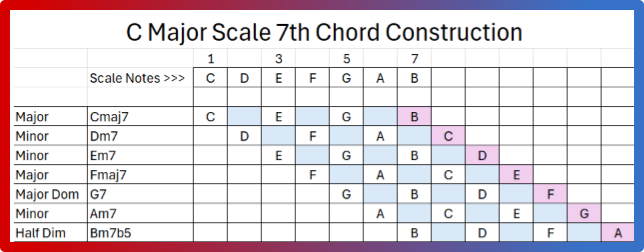
So if you know your major scale, creating chords is super easy. If you know your triads both major and minor, then to get a seven chord, you just add the 7 note to it. It will all make more sense soon enough, but it’s the foundation for everything that you need to know at present.
Root note patterns >>> CAGED shapes >>> TRIAD'S. Just put in the work and watch your guitar skills soar.
-
August 24, 2026 at 11:14 am #421574
It’s definitely starting to make more and more sense. It just usually takes a while to settle in and I have a lightbulb moment in the shower haha
-
-
-
AuthorPosts



- You must be logged in to reply to this topic.
