Home › Forums › Music Theory › CAGED SYSTEM FOR D CHORD
- This topic has 12 replies, 8 voices, and was last updated 7 years, 3 months ago by
 Paddyboy.
-
AuthorPosts
-
-
November 23, 2018 at 3:58 pm #117267
Man, this was a lot of work. It shouldn’t have taken as long as it did but I’m so “anal retentive” when it comes to mapping out this kind of stuff. I’m very much interested in learning… and being able to play lead guitar that I figure it’s always worth the effort for me, Especially since I’m retired. Lol
Keep in mind, this is only for a “D” chord but it shows the corresponding MAJOR pentatonic scale as well as the corresponding MAJOR scale for each of the 5 shapes. I know that this, along with being able to play and understanding double stops with 3rd’s and 6th’s is invaluable to learning to play lead guitar. Enjoy and hope it helps some of you.
Rgds, Pat FALL IT TAKES TO WRITE A SONG IS........3 CHORDS AND THE TRUTH!
-
November 23, 2018 at 4:03 pm #117269
opps sorry, here it is
Pat FALL IT TAKES TO WRITE A SONG IS........3 CHORDS AND THE TRUTH!
-
November 23, 2018 at 4:28 pm #117271
And for the encore in G here is —-5 POSITIONS OF THE G MAJOR SCALE USING THE CAGED SYSTEM
Rgds,
Pat F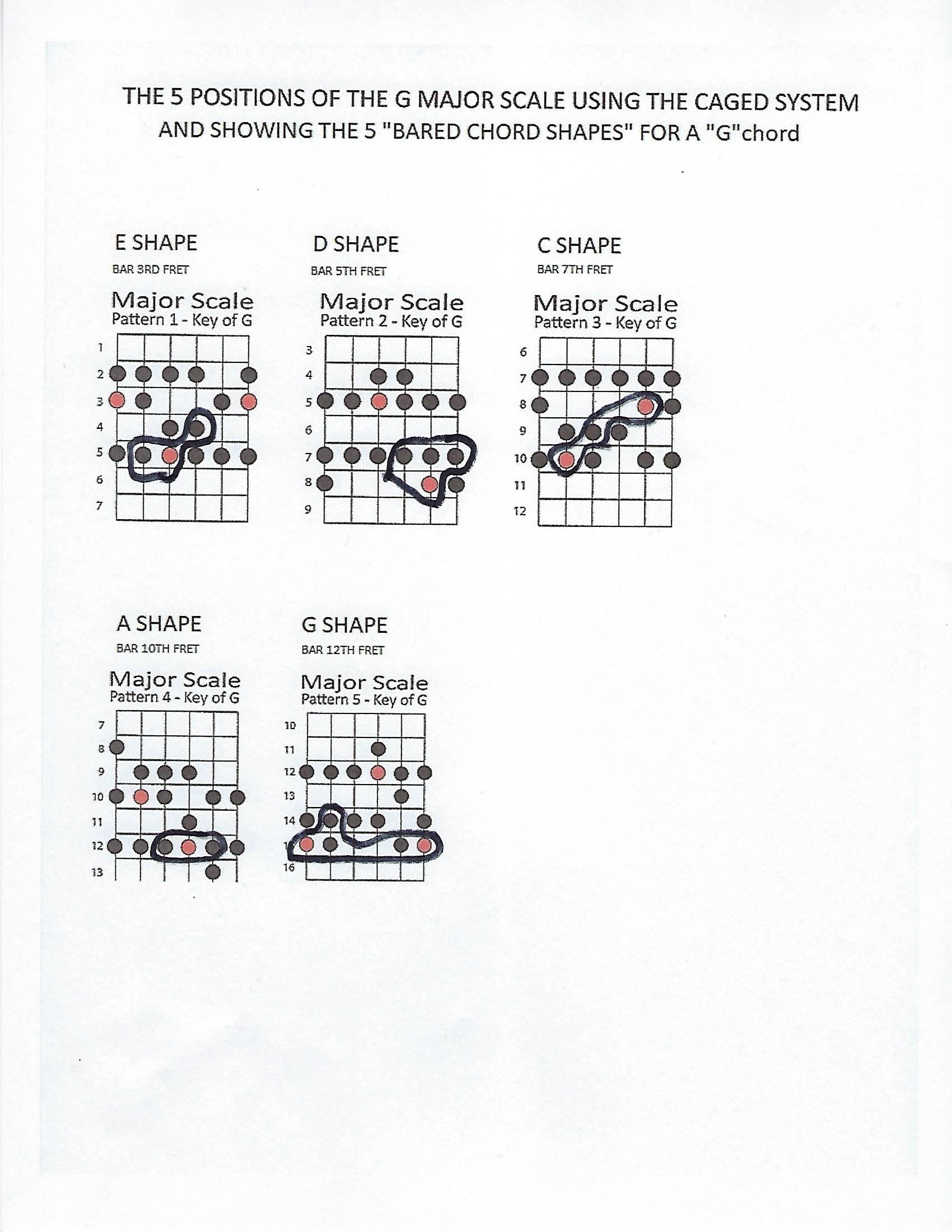
ALL IT TAKES TO WRITE A SONG IS........3 CHORDS AND THE TRUTH!
-
November 23, 2018 at 4:36 pm #117274
hahaha I need to learn how to use this system of posting stuff.
ALL IT TAKES TO WRITE A SONG IS........3 CHORDS AND THE TRUTH!
-
November 23, 2018 at 7:50 pm #117283
lots of work putting that together, thanks Pat.
CAGED can be intimidating at first glance, but really it’s very very helpful in learning to use the whole fretboard.
Lucky for me I learned it long time ago, and now I’m 100% constantly aware of CAGED shapes and positions when I’m playing.
-
December 8, 2018 at 1:31 pm #118404
That’s beautiful Moose. Me as well now. Intimidating at first but once you learn the 5 shapes you don’t necessarily have to play the whole shape all the time when chording. You can just play the top half and that works for chording or lead.
I find the G shape and D shapes are hard cause you have to stretch your bar.ALL IT TAKES TO WRITE A SONG IS........3 CHORDS AND THE TRUTH!
-
-
November 23, 2018 at 8:07 pm #117285
Pat,
Thanks for putting this together and I’m all in with what your doing. I have taken a look at CAGED and need to spend a lot more time on it. I find when I’m improvising I’m not looking at CAGED shapes but more the basic outline of the scale that the song is in and using some styles of playing and just my ear as to what sounds good. Always room for more theory and putting it into practice!
Tim -
November 23, 2018 at 10:42 pm #117289
Pat,
Many thanks for all of your hard work, and for making it available to all of us.I really appreciate being able to see the CAGED shapes ‘inside’ the scales.
I have been making a half-hearted attempt to learn this stuff – although I understood the concept long ago – and your diagrams will really help.
All the best,
Geert.
-
November 24, 2018 at 1:40 am #117293
Thank you Pat,
very useful to navigate on Scales and Fretboard. I copied it at once for my collection of those “Little Helpers”.
Dieter -
November 24, 2018 at 6:31 am #117308
Nice work, Pat. Now you might also add Major chord arpeggios as a 4th box to start thinking about chord tones in soloing and to begin to be aware of intervals within the shapes.
John -
November 24, 2018 at 2:56 pm #117350
And then there is “ear training”, which is the zen method of navigating your guitar fretboard. I found it virtually impossible to use ear training apps to learn the intervals. But what has happened over time (about 3 years) is that if I am playing a scale or a melody, I just automatically know where to put my finger to get the note I want. If it’s more than about 6 – 7 half steps away, my accuracy is not 100%. I found that practicing scales or melodies all on one string increased my skill. Like, can you play Happy Birthday on one string with no errors?
Sunjamr Steve
-
November 24, 2018 at 5:25 pm #117360
Bottom line in my humble opinion is this,, if one has to ask or has no clue about the Caged system,, the best advice I can give here is simply learn the concept inside out before proceeding to the other really basic guitar theory fret board stuff ,,taking for grant you know the really basic open chords and meaning of terms like diatonic scales chords progressions intervals major minor 7th chords .. if you don’t have basic understanding ,,you will always struggle until you learn the basic terminology/ theory on the fret board.
-
November 25, 2018 at 12:21 am #117381
And then there is “ear training”, which is the zen method of navigating your guitar fretboard. I found it virtually impossible to use ear training apps to learn the intervals. But what has happened over time (about 3 years) is that if I am playing a scale or a melody, I just automatically know where to put my finger to get the note I want. If it’s more than about 6 – 7 half steps away, my accuracy is not 100%. I found that practicing scales or melodies all on one string increased my skill. Like, can you play Happy Birthday on one string with no errors?
sunjamr Steve,
Does your ‘ear’ improving in this way mean that your playing has improved? For example, when improvising, do you sometimes just ‘know’ where to go to get a particular sound, or – in the case of intervals that you mentioned – can you think of an interval from a chord and know how or whether it will fit with the rest of the solo you are playing?
-
-
AuthorPosts








- You must be logged in to reply to this topic.
