Home › Forums › Active Melody Guitar Lessons › Time Signatures
- This topic has 8 replies, 5 voices, and was last updated 1 year, 9 months ago by
 Mark T.
-
AuthorPosts
-
-
March 17, 2024 at 10:04 am #366819
Hey everyone,
I’ve been learning with Active Melody for a couple of years and totally love it. I’ve learned loads. Never posted on the forum though!
I wondered has there ever been a rhythm lesson that explains different time signatures and how to understand them? 4/4 is ok – but I get confused with 3/4 6/8…it’s a mystery. Has Brian ever created this content?
Thanks
Mark
-
March 17, 2024 at 2:26 pm #366837
Good question Mark. I can’t think of one that is dedicated to time signatures. There’s a few where the time signature is something that’s not 4/4 and Brian will tell you how to count it and maybe give a cursory explanation.
I know the basics of the definition ie <number of beats in bar>/<note type that constitutes a beat ie quarter note , eighth note etc>
But what makes a 6/8 different from a 3/4 with twice as many bars would be interesting to know. -
March 17, 2024 at 3:48 pm #366843
Or, how about 12/16? That would be funk music in 3/4 time.
Sunjamr Steve
-
March 17, 2024 at 4:29 pm #366844
A funky waltz!! I bet johann strauss never thought of that 😀
-
-
March 17, 2024 at 7:30 pm #366851
That is a good question Mark, the most common signatures are 3/4, 4/4 and 6/8. I will add another question, I know from the 1-2-3-4 as quarter notes is (4/4 time). Could someone attach the missing time signatures to the following rhythm beats: 1 & 2 & 3 & 4 & as 8th notes (? time); 1 & a 2 & a 3 & a 4 & a as Triplets is (3/4 time) and 1 e & a 2 e & a 3 e & a 4 e & a, as 16th notes (? time). I have used tapping the foot and clapping the beats out to feel the rhythm, so the practical is there. Thanks.
The attached video explains time signatures well but I am sure there are more. A good one for a MicroLesson to demystify this topic.
-
March 18, 2024 at 2:58 am #366856
OK, time signatures…
Reminder:
The relative rhythmic values of the notes in music are:
1 whole note = 2 half notes = 4 quarter notes = 8 eighth notes = 16 sixteenth notes = etc.
There are also dotted notes, whose lengths are 1.5 times that of the corresponding non-dotted version. A dotted half note = three quarter notes, a dotted quarter note = three eighth notes, etc.Time signatures are indicated by two stacked numerals, or a fraction sign. For example: 2/4, or 6/2, 9/4, etc.
Time signatures are subdivided into:
– simple meters
– compound meters1. Simple meters
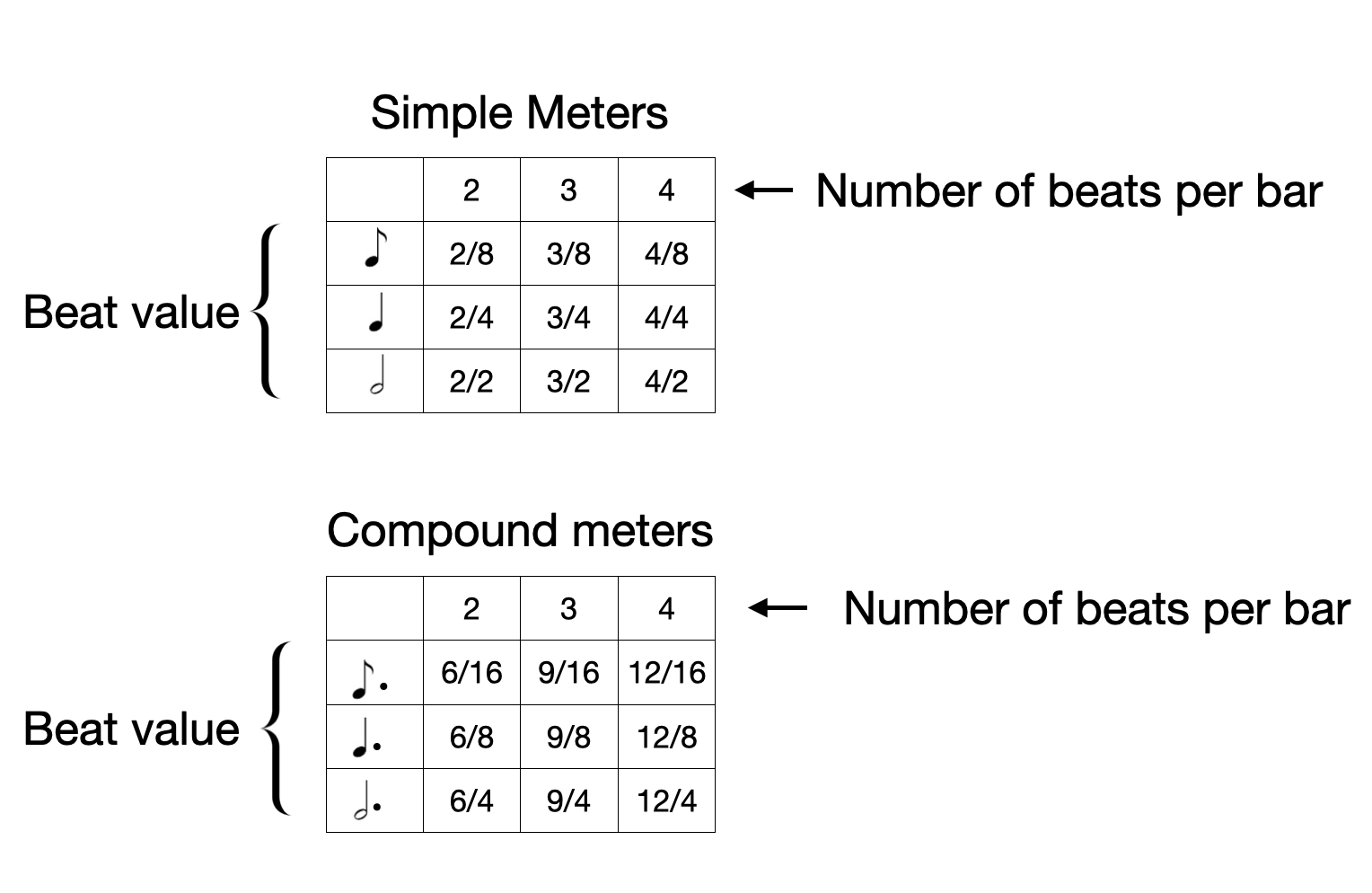
When the upper numeral is 2, 3 or 4, the time signature is said to be “simple”. In that case, the well known definition applies: the lower number indicates the type of note used as reference, and the upper number indicates how many of them there are in each bar.
For example:
– 3/4 indicates three quarter notes per bar
– 4/4 indicates 4 quarter notes per barIf we notate strong beats with “v” and weaker beats with “-“, we have:
4/4: |v – (v) – |v – (v) -| etc. (a quadruple meter)
3/4: |v – – |v – – | etc. (a triple meter)
2/4: |v – |v – | etc. (a duple meter)
3/8: ||v – – |v – – | etc. (another triple meter)2. Compound meters
When the upper numeral is 6, 9 or 12, the time signature is said to be compound, and the basic definition above does NOT apply.
In that case, the rhythmic unit is a dotted note.
So, for compound meters, the lower numeral indicates the reference note, but taken in groups of three, and in order to know how many beats there are in each bar, you have to divide the upper numeral into three.Let’s take 6/8 for example:
The rhythmic unit is three 8th notes, or a dotted quarter note. There are 6/3 = 2 such dotted quarter notes in each bar.Other example: 9/4
The rhythmic unit is three quarter notes, that is to say a dotted half note, and there are 9/3 = 3 such dotted half notes per beat.While 6/8 is mathematically equivalent to 3/4, it does not at all represent the same rhythmic structure! 3/4 is a triple meter (walz time), but 6/8 is a duple meter. If you listen to a jig, you’ll naturally tap your feet twice per bar, not three times per bar. In New Orleans jazz music, many marches are written in 6/8…
So, in one of the posts above, 12/16 is NOT equivalent to 3/4. Because the upper numeral is 12, we are dealing with a compound meter: we need to take three 16th notes = one dotted 8th note as unit. And there are 12/3 = 4 of them in each bar. So 12/16 is a quadruple meter that does not at all feel like a walz!! Again: the mathematical equivalence is totally misleading.
3. Tempo
The time signature determines the rhythmic structure of the song, but not how fast or slow you should play it.
In classical music, the tempo is often indicated by a metronome value, as follows:
(Note symbol) = value.
For example: (quarter note symbol) = 120, which would mean 120 quarter notes per minute.
Older scores also contain the Italian indications: presto, largo, andante, etc. These indications are rather imprecise and their interpretation has varied along the centuries.Another more contemporary way of giving the tempo is the “bpm” or “beats per minute” indication. For example, 70 bpm indicates 70 beats per minute, whatever the rhythmic unit (quarter, eighth, dotted half, …).
Playing 70 quarter notes per minute means that you have to play 140 8th notes per minute and 280 16th notes…Just to make the whole story even more confusing: the blues and all music derived from the blues is usually indicated in 4/4, but with a “shuffle” or “swing”. That makes the rhythm closer to a 12/8 (some blues songs actually use this very time signature). But a shuffle is not exactly the same as a dotted unit. It’s more like a little rhythmic delay… more like playing laid back, slightly behind the beat.
Anyways. There you have it. Hope this helps.
-
March 18, 2024 at 9:04 am #366862
That was awesome Jean-Michel! Thanks🙌. I kinda’ knew that 3/4, 6/8 and 12/16, though mathematically equivalent, sounded different so my comment was very ‘tongue in cheek’, but this is the first time I’ve seen a description that describes why and that I could understand 👍
-
-
March 18, 2024 at 4:24 am #366857
This visual should help clarify my previous post:
-
March 18, 2024 at 1:39 pm #366864
Thanks for taking the time to reply everyone – some really useful stuff. I’m going through it line by line to try and make it stick in my brain – but definitely demystified 4/4 3/4 6/8 which is a great starting point. Thanks again x
-
-
AuthorPosts





- You must be logged in to reply to this topic.
